
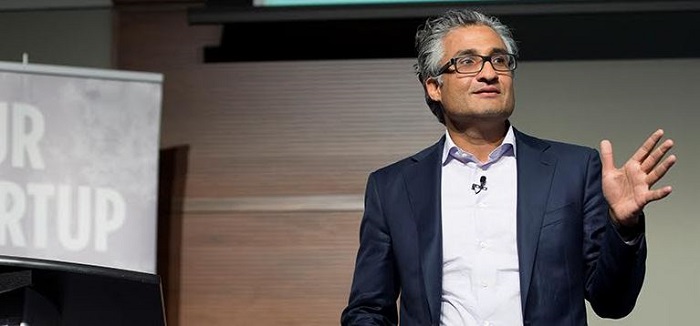
When Reza Satchu, Senior Lecturer at Harvard Business School and founder of NEXT Canada, an entrepreneurial incubator, talks about building a business from scratch, he speaks from experience that is as personal as it is professional. Born in Mombasa, Kenya, Satchu arrived in Scarborough, Ontario, as a scrawny kid with a funny accent, trying to find his footing in a very different world.
“There was a lot of discomfort,” he recalls in an interview. “We were far less involved in our immigrant community because my parents really wanted us to immerse ourselves in the Canadian community.”
Those early challenges taught Satchu a lesson that would become central to his entrepreneurial philosophy: commitment matters more than circumstance. In his family, his mother worked as a secretary, and his father as a real estate agent. After graduating from McGill University, Satchu sent out hundreds of resumés and faced near-total rejection. But when one woman at Merrill Lynch took his call, Satchu drove overnight from Montreal to New York to meet her.
“All it takes is one lucky break,” he says.
This mindset of moving forward even without perfect conditions for success would define Reza Satchu’s career. He emphasizes that good business ideas are not rare – his kids have them, his wife has them, and anyone in business school has surely had a few. What is rare is the willingness to act on these ideas without certainty, without waiting for all the stars to align.
Many transformational companies started with seemingly straightforward ideas, like Amazon selling books or Tesla making electric cars. What made the difference was the founders’ willingness to commit without resources and build something against long odds.
“You can’t compete with someone who is fully committed. That is where the magic happens,” says Satchu.
Satchu’s “Founder Mindset,” which he imparts to his business students at Harvard, stresses that judgment—the ability to make high-stakes decisions with limited information—is crucial. And like any muscle, it gets stronger with use. For new entrepreneurs, every chance they get to exercise their judgment on consequential decisions for which they will be held accountable is invaluable. They will need to bank dozens of these to prepare for the moment when one or two consequential decisions will make the difference between the success and failure of their long-gestating business idea.
For many in Silicon Valley, failure is wielded like a badge. Many of the most successful tech entrepreneurs have tried and failed over and over, only to return with better judgment, fresh ideas, a fresh approach, and a renewed sense of resilience and purpose. They have shown that they are willing to back themselves and their ideas when no one else does. For venture capitalists, that quality usually separates the wheat from the chaff.
Satchu believes that more Canadians need to nurture this quality of self-belief and high expectations for themselves and their businesses. Through programs like Next 36 and Economics for Entrepreneurs at the University of Toronto, he is focused on closing what he sees as a “prosperity gap” between Canada and the U.S, one which he believes comes down to belief.
“The major disadvantage I had coming out of McGill was that I had more modest expectations,” said Satchu. “Whereas kids at Harvard, Yale, Stanford – through their interactions with CEOs, they get to see what is possible.”
Business leaders should “go with their gut” and commit to an idea they believe is worth backing. If they fail, they can add a star to their helmets and move on to the next one. But if they succeed – they may create the next great Canadian company.







Leave a Reply